
Thinking About a Tokyo Street Kart Tour with Kids? 4 Steps to Check, Starting with the Fact That Karts Are Single-Seaters
Thinking About a Tokyo Street Kart Tour with Kids? 4 Steps to Check, Starting with the Fact That Karts Are Single-Seaters
"We're traveling with a little one. Can we still ride karts in Tokyo?"
When you're trying to pick a destination, a single question like this can stop you cold. You want to look it up, but you're not sure where to start. You don't know much about how bookings work in Japan, either. That goes double if it's your first trip to Japan.
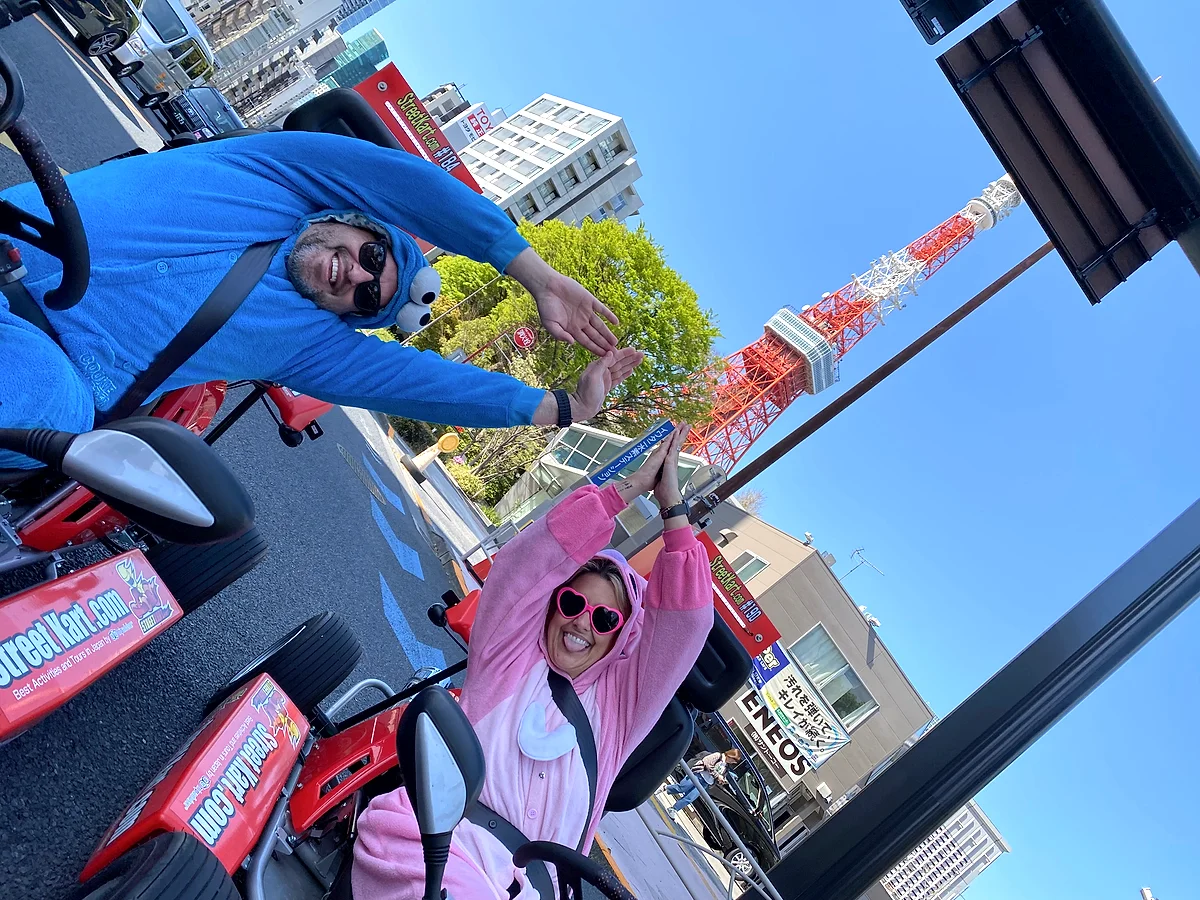
So here's the answer up front: Street Kart karts are single-seaters. Your child can't sit on your lap or ride next to you.
Disappointed? Don't be. Now that you know this, half your research is already done. Only two questions are left: who will drive, and what the non-drivers will do while they wait. This article breaks that down into four steps and goes through them one at a time.
First, the Basics: Karts Are Single-Seaters, and Each Location Has Set Routes
Get this clear first and the rest gets much easier.
Street Kart isn't a rental where you drive off wherever you like. It's a guided tour: a guide drives at the front and participants follow. Each location has its own set routes.
Honestly, this is good news for whoever is doing the planning. You don't have to study maps. You don't have to agonize over where to drive. That alone takes one thing off your research list.
The trade-off is that your child can't ride along. So the question "Can I join with my kids?" is better phrased this way: "While the adults are driving, what will the kids and the rest of the group do?"
If you're used to everyone traveling together in one vehicle, you might be surprised that you can't ride together. But on this tour, each person drives their own kart. Make that mental shift now, and you won't get stuck later.
It also helps to know roughly how the day goes. When you arrive at the store, you check in, have your driver's license checked, and go through a safety talk and briefing, a basic lesson on operating the kart, and an explanation of the route. Then you set off behind the guide, drive the set route, and stop at photo spots as you tour the sights. Finally, you return to the store and hand back your kart. In other words, drivers are away from the store from departure until they get back. What the people waiting need to plan is how to spend that time away.
Step 1: Decide Which Adult Will Drive, and Check the Driving Requirements
The first thing to do is decide who will drive, and then confirm that person meets the requirements.
In Japan, visitors from overseas need specific documents to drive, depending on their country. Which documents are accepted depends on the country that issued your license. If you just assume "it'll probably be fine," you could end up unable to ride on the day.
So rather than hunting around the internet, it's much faster to read one official page. Driver's license information is gathered on the official driver's license page. That's also the most reliable place to check other driver requirements, such as age. Please see the official website for full details.
There's one thing about documents you should know in advance. You need your original physical license; digital licenses are not accepted. If you don't have the required documents on the day, you can't take part, and you won't get a refund. When you pack, keep them in the same place as your passport.
A tip: if there are two or more adults, check everyone's eligibility now, all at once.
"Dad can drive, but it turns out Mom's license isn't accepted." Find that out right before you leave, and you'll have to rebuild your whole plan. But right now, before you've even chosen a destination, you haven't lost anything. A little time spent here will make everything after it much easier.
One more thing that matters for family trips: pregnant people are advised not to take part. The karts have no suspension, and the roads are bumpy. If an adult who plans to drive is pregnant, please talk to a doctor first. Check this now, while you're deciding who will drive.
Step 2: Put All Your Questions into One Inquiry
Once you know who's driving, the next step is getting in touch. This is a key moment where you can save yourself a lot of effort in one go.
You can reach them through Facebook, LINE, email, and other channels. Please check the official website for the current contact options. By the way, the Chinese word for a reservation is "預約 (yùyuē)." In Japan, too, the norm is to book travel activities in advance. It's safer not to plan on just showing up and riding.
Also, weekends tend to fill up. If you want to ride on a Saturday or Sunday, contact them early.
The key with this inquiry is to settle everything in one exchange. If you send questions one at a time, days pass every time you wait for a reply. That's especially true if you're writing from another time zone.
Here's the kind of thing to put in that one message: how many people will drive; how many children and their ages; whether the non-driving companions and children can wait at the store during the tour; how much time to allow from meeting to finish; whether two adults can join separate sessions if they want to take turns; and which location you prefer.
When booking, you're asked to provide the country that issued your license, the number of drivers, your preferred date and time, and the location. Before you send, check that all four are in your message. For the issuing country, just copy over what you confirmed in Step 1. They say they reply within 24 hours.
Tour length varies by location and plan. I can't give a definite answer here, so ask about it in the same message.
Sort out any language worries at this stage too. The website is available in 22 languages, so you can read through it first in whichever language suits you best. On the day, though, the tour is generally guided in English. Whether guidance is available in Japanese or other languages depends on the staff that day, so it isn't guaranteed. If you're not confident in English, mention that in your inquiry too.
A few words on what comes after booking. With kids, plans can change suddenly, say if someone comes down with a fever. Cancellation is free up to 7 days before. After that, the cancellation policy applies, so read it before you book. Payment must be made in full in advance via PayPal; you can't pay part of it at the store. Several people can pay separately using the same PayPal link.
Pack all your questions into one message. It's unglamorous, but I think it's the simplest way to save time.
Step 3: Decide Where the Non-Drivers Will Spend Their Time Near the Store
While you wait for a reply, think about where the non-drivers and kids will spend their time.
One caution: every place listed here is near a store. None of them are on the tour routes. Think of them as options to visit before or after the tour, or while you wait for the drivers.
There are seven locations in Tokyo. However, Akihabara Store 1 and Store 2 are in almost the same spot, and so are the Shibuya store and Shibuya Annex. So they aren't spread across seven separate areas. When choosing a location, it's easier to decide by asking which area you'd like to wait in.
From the Akihabara stores, Ueno Park is about 5 minutes away by train. That's where Ueno Zoo is. For waiting with small children, I think it's a good choice. Ueno Park also has the Tokyo National Museum and the National Museum of Western Art, so if your kids are a bit older, those are options too. Kanda Myojin, about a 10-minute walk from the store, is a shrine with 1,300 years of history. Say a prayer and take a few photos, and the wait turns into a little sightseeing trip.
From the Shinagawa store, Shinagawa Shrine is about a 5-minute walk away. On the grounds is a Fujizuka, a small mound built to look like Mount Fuji, and you can climb it. Huffing up the stone steps and standing at the top: kids love this kind of thing, don't they? Tennozu Isle, about a 20-minute walk away, is a canal-side area lined with cafés and galleries. A slow stroll along the water isn't a bad way to wait, either.
From the Shibuya stores, Yoyogi Park and Meiji Jingu are each about a 20-minute walk away. It's a big stretch of green right in the middle of the city. Take a deep breath in the shade of the trees. For families with kids, I think it's more relaxing than the crowded streets of Shibuya.
From the Tokyo Bay store (Shinkiba), Kasai Rinkai Park is about 15 minutes by car, and Odaiba is about 10 minutes by car. Both are driving distances. If the people waiting plan to go that far, decide how they'll get there in advance. Kasai Rinkai Park has a giant Ferris wheel and Tokyo Sea Life Park.
Plan a rainy-day waiting spot, too. In light to moderate rain, the tour runs as scheduled, and drivers are given raincoats. That means if it rains on a tour day, the people waiting will also be out in the rain. Include at least one covered spot, not just outdoor places like parks, and you won't be caught off guard. In heavy rain or a typhoon, the tour is canceled, and you choose between a shortened tour (with the difference refunded), rescheduling, or a full refund.
Decide on a meeting point now too, so things don't get hectic on the day.
Step 4: Take the Train on the Day, and Pack Light
Last, here's how to handle the day itself.
First, the stores have no parking. Plan to get there by train or other public transportation.
Be on time for your reservation. This is an important bit of etiquette in Japan. If you aim to arrive a little early, you'll feel more relaxed too. Since there's check-in and a safety briefing, arrive at the store 15 minutes before your booking. Walking with a child by the hand often takes longer than you expect, so factor that in when deciding what time to leave the station.
Here's roughly how far each store is from the station: Akihabara Store 1 is about a 5-minute walk from Akihabara Station and about a 3-minute walk from Suehirocho Station. The Shinagawa store is about a 3-minute walk from Kita-Shinagawa Station. The Shibuya store is about a 5-minute walk from Shinsen Station. The Tokyo Bay store is about an 8-minute walk from Shinkiba Station.
Now, about luggage. Every store has a convenience store within a 5-minute walk. The stores have restrooms and Wi-Fi. Keep these in mind when deciding what to bring.
Drivers should also pay attention to what they wear. Wear closed-toe shoes, ideally sneakers. Avoid open-toed shoes like sandals, as well as heels, skirts, and dresses. Only a small bag will fit on the kart. The stores have lockers for small items, but they aren't suited to big luggage like suitcases. Before heading out, decide whether the people waiting will hold onto large bags or whether you'll leave them at the hotel.
In Japan, convenience stores are everywhere in daily life. Spotting a familiar sign while traveling can be a small relief, can't it?
What Makes Street Kart Fun: The Same Things That Cut Down Your Prep
If you've read this far, you may have noticed something: the same things that cut down your prep work are what make Street Kart fun.
First, a guide leads the way. A trained guide drives in front, so drivers can focus on the scenery in front of them instead of memorizing the route.
Next, the routes are set. Not being able to drive anywhere you like might look inconvenient, but it actually saves you all the time you'd spend deciding where to go. The Shibuya tour passes through Harajuku and Omotesando, and on the Tokyo Bay tour, the Rainbow Bridge comes into view. The classic Tokyo sights are lined up along the road from the start.
Some Akihabara tours also pass Tokyo Station and Ginza. You drive past the red-brick station building, opened in 1914, with your own hands on the wheel. Being able to tell the people who waited, "I drove past Tokyo Station!" is a nice bonus.
And then there's the feeling of driving a kart itself. Feeling the wind, hearing the sounds of the city, steering your own way through the buzz of the intersections. Just imagining it is a little exciting, isn't it?
There's also something you can know about language in advance: the website is readable in 22 languages, and on the day the tour is generally guided in English. Keep those two points in mind and planning gets easier.
Let's look at the track record too. As of November 2023, the total number of tours run across all locations was over 150,000, with more than 1.34 million customers in total. There were over 20,000 reviews, with an average rating of 4.9 out of 5.0. All of these figures are as of November 2023, so just keep in mind that current numbers will be different.
Before You Choose a Destination, Start by Sending One Message
When you're thinking about a kart experience in Tokyo with kids, the first thing to know is simple. The karts are single-seaters. So all you need to work out is the driving requirements for the adults and how the people waiting will spend their time.
You can check the driving requirements on the official website. You can put all your questions into one message. You can choose where the waiting group goes from the areas around the store. And on the day, take the train.
Since your destination isn't decided yet, you can see what you find out first and then plan your Tokyo itinerary. Weekends tend to fill up, so if you're aiming for one, get moving early.
Start by checking the contact options on the official website, then put your questions together into one message and send it.
Once you've hit send, all that's left is to wait for a reply. In the meantime, decide together: will it be the animals in Ueno, or the little Mount Fuji in Shinagawa?
This article was originally written in Japanese and translated using AI. Some expressions may read unnaturally, and we appreciate your understanding. For the most accurate and up-to-date information, please refer to the official site at kart.st.
Street Kart is not affiliated with Nintendo or the Mario Kart series in any way. We do not provide costumes of Nintendo characters, and such costumes may not be worn during tours even if brought by participants.