
Riding a Street Kart in Tokyo: How to Plan Around It and Estimate the Time from Check-In to Wrap-Up
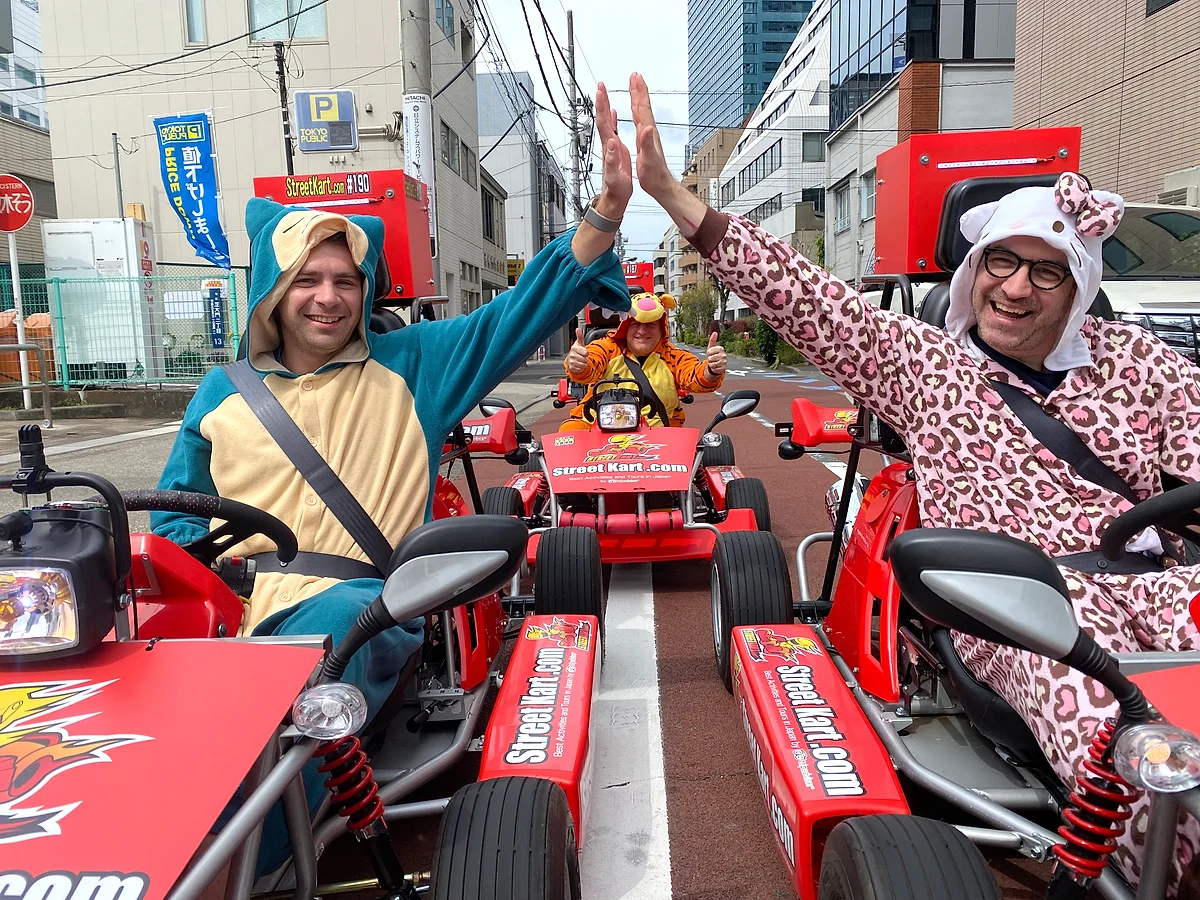
Riding a Street Kart in Tokyo: How to Plan Around It and Estimate the Time from Check-In to Wrap-Up
You've booked a street kart tour. On a day like that, where do your Tokyo sightseeing plans usually fall apart?
It's not the time you spend in the kart. It's the time before and after.
You leave the station, find the shop, and check in. Once the ride is over, you head to your next stop. Misjudge these in-between stretches and you'll arrive at the tour you were looking forward to completely out of breath. Even after the ride, you'll spend the whole time checking the clock. That's a waste.
This article explains how to estimate your time, written for people visiting Japan for the first time. It's fine if you haven't picked a Tokyo location yet. We'll go step by step through how to fit the time from check-in to wrap-up around your other plans.
First, the basics: a street kart ride is a guided tour
Start here. Most of your planning depends on this one point.
Street Kart's street kart rides are guided tours. Each location has a set route, and the whole group drives behind the guide. You can't go wherever you like or make side trips.
If you're used to something like a scooter in Taiwan, where you can say "want to stop over there for a bit?", this may surprise you at first. But for planning, it actually makes things easier. You can treat the tour, from start to finish, as one fixed block. Whatever happens inside that block is the guide's job. Thinking of it this way takes a lot of weight off your mind.
That said, the length of the block varies by location and plan. I won't say "it takes X hours" here. Please check the latest durations on the Street Kart official website.
One more thing: guidance on tour day is generally in English. Whether you can get guidance in Japanese or other languages depends on the staff that day, so nothing is guaranteed. If this matters to you, contact them in advance through the official website. The website itself is available in 22 languages.
Split the time from check-in to wrap-up into four parts
If you plan around the tour time alone, you'll usually come up short.
The trick is to split the time from check-in to wrap-up into four parts.
The first part is getting from the station to the shop. In Tokyo, you'll mostly get around by train and on foot. Street Kart locations don't have parking, so please use public transportation.
According to the source material, the walking times from nearby stations are:
The Shibuya location is a 5-minute walk from Shinsen Station and 10 minutes from Shibuya Station. The Shinagawa location is a 3-minute walk from Kita-Shinagawa Station and 10 minutes from Shinagawa Station. The Tokyo Bay location is an 8-minute walk from Shin-Kiba Station. In Akihabara, the 1st shop is a 3-minute walk from Suehirocho Station and 5 minutes from Akihabara Station, and the 2nd shop is a 7-minute walk from Akihabara Station.
There's one catch, though. If it's your first visit, leave some time for getting lost.
On your first trip to Tokyo, taking the wrong station exit can eat up more time than you'd expect. Big stations like Shibuya and Shinagawa have a lot of exits. Coming up to street level and thinking "wait, which way am I facing?" happens all the time. Add a little extra to the walking time in your map app to cover this.
The second part is the time between arriving at the shop and setting off. You'll need to check in and get a briefing before you drive, among other things. For how early to arrive, follow the instructions you receive when you book.
To drive in Japan, you have to meet certain driver's license requirements. The required documents are listed on the driver's license information page. Don't just skim part of it. Read the whole page and bring everything listed. See the official website for details.
If you find out on the day that you're missing a document, time estimates won't matter anymore. Get this sorted out by the day before at the latest.
The third part is the tour itself. As explained above, treat it as one fixed block and don't try to move it.
The fourth part is the time between wrap-up and moving on to your next plan.
Right after the ride, you'll probably still be buzzing. You'll look back through your photos and tell the people you drove with, "That part was amazing!" Some people will stop by the restroom before leaving. The shop has restrooms and Wi-Fi, so it's also a good place to double-check the route to your next destination.
If you count this fourth part as "zero minutes," your next plan will run late right away.
Chinese has a word for this, "留白" (liúbái): leaving empty space on purpose. That idea really helps here. Leave a buffer both before and after the tour, then arrange your other plans around it.
What should you schedule before and after?
Once you know the four parts, the next question is what to put before and after. The idea is very simple.
Before the tour, schedule things where you decide when they end.
Walking around a shrine, taking a break at a café, browsing a station shopping complex. With plans like these, you can cut things short if you're running late.
On the other hand, don't schedule a movie with a fixed showtime or a timed-entry ticket right before the tour. If either runs long, you'll be late for your kart check-in.
After the tour, schedule things that don't have a strict start time.
If you book a dinner reservation right after the tour ends, your buffer is gone. Go for a walk or do some shopping first after the ride, and save anything with a set time for later. Doing things in this order makes the day much easier.
Also, drinking and driving is illegal in Japan. Save the toast for after the tour. It'll taste better then anyway.
In Japan, you can count on trains running on schedule. Transit apps give you directions down to the minute. That's exactly why it's easy to trust the "fastest route" too much and pack your plans with no buffer at all. The trains may be on time, but the time you spend lost in an unfamiliar station isn't in any timetable.
When you book is part of your time planning too. Weekends fill up fast, so if your date is already set, book early. If you can't get the slot you want, you'll have to rearrange everything before and after it.
Planning around each Tokyo location
There are seven locations in Tokyo.
But Akihabara's 1st and 2nd shops are almost in the same place, and so are Shibuya and Shibuya Annex. So they aren't spread across seven separate areas. Here, I'll cover Shibuya, Akihabara, Shinagawa, and Tokyo Bay (Shin-Kiba), whose surroundings I could confirm in the source material. If you can't decide, start by comparing where these locations are.
The "places to visit" mentioned below are near each shop. You can't stop at them in your kart during the tour. Keep them separate from the places the route passes through.
Shibuya: separate the places you see on the route from the places you explore on foot
According to the source material, highlights the Shibuya tour passes include Shibuya Scramble Crossing, Takeshita Street in Harajuku, and the zelkova tree-lined avenue of Omotesando.
The key here is to separate "places you'll pass by kart" from "places you want to explore on foot."
Take Omotesando. From the kart, the trees and buildings will probably glide past you. If you want to look around inside Omotesando Hills or stop at a café, though, you'll need to set aside separate walking time. It's the same Omotesando, but a tour and a stroll use different kinds of time.
Good spots to visit before the tour are the Hachiko statue and the area around Scramble Crossing, about a 10-minute walk from the shop. Since it's a famous meeting spot, it also works well for meeting up with friends. But the crowds around the crossing are huge, and they'll slow you down. If you're heading to the shop from there, leave a little earlier than you think you need to.
After the tour, try somewhere you can walk at a relaxed pace, like Meiji Jingu, about a 20-minute walk away. Letting the thrill of the ride fade slowly in the quiet of the forest is a sequence I really like. Shibuya Sky, the observation deck at Shibuya Scramble Square, is also about a 10-minute walk from the shop. The view changes with the season and the weather, so feel free to decide when to go based on the sky that day.
Akihabara: check which shop you booked first
In Akihabara, start by checking whether you booked the 1st shop or the 2nd shop.
They're in almost the same area, but you'll enter a different location in your map app. If you only remember "Akihabara," you'll end up searching after you reach the station.
According to the source material, highlights on the Akihabara route include the red-brick Marunouchi Station Building of Tokyo Station, the streets of Ginza, and Akihabara Electric Town. From the kart, the station building, opened in 1914, probably won't fill your view like it would through a window. You'll be looking up at it.
Now let's think about how to keep your plans before and after from overlapping with the route.
After seeing Tokyo Station from the kart, you could visit the Tokyo Station Gallery inside the building. "Seeing it from outside" and "going inside" are different experiences, so this combination works well, even though it's the same place.
One option before the tour is Kanda Myojin, about a 10-minute walk from the shop. It's known as the guardian shrine of old Edo. You decide how much of the grounds to walk, so it's a good kind of plan to put before the tour.
After the tour, Electric Town is right there for exploring. According to the source material, Yodobashi Camera Akihabara and Animate Akihabara are just a few minutes' walk away. Shopping has no set start or end, so you can stretch your post-tour buffer as long as you like. Another good option is going on to Ueno Park, about 5 minutes away by train, and walking around the area with its art galleries and museums.
Shinagawa and Tokyo Bay: build around the bay views, and plan inland before and after
According to the source material, both the Shinagawa tour and the Tokyo Bay (Shin-Kiba) tour feature Rainbow Bridge and Tokyo Tower as highlights.
The 798-meter suspension bridge and the 333-meter red-and-white tower are classic Tokyo waterfront views, and you'll see them during the tour.
So your plans before and after should go in a slightly different direction.
In Shinagawa, visit Shinagawa Shrine before the tour. It's about a 5-minute walk from the shop. You can walk up the stone steps to the Fujizuka (a miniature Mount Fuji mound) at your own pace. The shop is a 3-minute walk from Kita-Shinagawa Station, so getting from the shrine to the shop is easy to plan.
After the tour, you could take a stroll along the canals at Tennozu Isle, about a 20-minute walk away, or eat at atré Shinagawa, which connects directly to Shinagawa Station. Shinagawa Station is also a Shinkansen stop. If you're leaving Tokyo the same day, leave extra buffer after the tour. Getting through several ticket gates with large luggage takes longer than you'd think.
The Tokyo Bay location is an 8-minute walk from Shin-Kiba Station. Here, the key is to decide in advance what you'll do once you take the train to your next stop. Shin-Kiba Station is served by the JR Keiyo Line, the Tokyo Metro Yurakucho Line, and the Rinkai Line. Decide which line you'll take before you leave the shop, and you won't get lost. There's also CASICA near Shin-Kiba Station, which is handy if you have time to spare before the tour.
What makes Street Kart special, in terms of how you spend your time
If you've read this far, you might be thinking, "Isn't this a lot of planning?"
For reference: as of November 2023, across all locations, Street Kart had run more than 150,000 tours, with more than 1.34 million customers, more than 20,000 reviews, and an average rating of 4.9 out of 5.0. These aren't current figures, so treat them as a rough guide.
But in terms of how you spend your time, what matters is how the ride itself feels.
The city you look up at through your helmet and goggles is different from what you see on foot or through a train window. The building walls feel close. You hear the traffic signals and the noise of the city directly. The wind hits your face. If you cram too much into your plans before and after, you won't have room to enjoy any of this. That's really the reason to leave a buffer.
What to decide before you book
To finish, here's what to decide before booking so the day goes smoothly.
Choose a location based on the views you want to see. Check the tour length on the official website. Look up the nearest station and the walking time from there, and add extra in case you get lost. Read the driver's license information page all the way through and get all the required documents ready. Then schedule plans you can end early before the tour, and plans with a flexible start time after it.
If you work through it in this order, the time from check-in to wrap-up will have its own proper place in your schedule.
Bookings are accepted via Facebook, LINE, and email. Contact details are on the official website. Weekends fill up fast, so if your date is already set, start by checking plans and locations on the Street Kart official website and grab a slot early.
You can take your time with the plans before and after once that's done.
Just make sure you keep the time for the kart ride free.
This article was originally written in Japanese and translated using AI. Some expressions may read unnaturally, and we appreciate your understanding. For the most accurate and up-to-date information, please refer to the official site at kart.st.
Street Kart is not affiliated with Nintendo or the Mario Kart series in any way. We do not provide costumes of Nintendo characters, and such costumes may not be worn during tours even if brought by participants.