
Karting Through Tokyo in Autumn Leaf Season: Omotesando's Tree-Lined Avenue, Plus a First-Timer's Guide from License Checks to Booking
Karting Through Tokyo in Autumn Leaf Season: Omotesando's Tree-Lined Avenue, Plus a First-Timer's Guide from License Checks to Booking
In autumn, Tokyo's street trees slowly turn yellow and brown. On a street kart you drive under those trees and look up at them from a seat that sits just above the pavement.
Still, if it's your first time in Japan, the questions start before you even get in: "Can I just drive anywhere?" "What about my license?" "Where do I go?" This article goes through each step, from booking to the day itself to what to do after the tour, and points out the routes that look best in autumn leaf season.
Step 1: Know That This Is a Guided Tour
If you remember one thing, make it this: a street kart is not a rental car. This really matters.
Every Street Kart experience is a tour. Participants drive behind a guide, and each location has its own set route. You can't choose where to go or leave the course partway through.
As of November 2023, the company had run more than 150,000 tours across all locations, with more than 1.34 million customers, more than 20,000 reviews, and an average rating of 4.9 out of 5.0. These numbers are from November 2023, so check the official website (kart.st) for current figures.
You might think, "So it's not really free driving." For first-timers, though, that's actually a good thing. Japan drives on the left, and finding your way through intersections in a city you don't know is hard work. You don't have to learn the route or keep checking a navigation app. You still follow the traffic rules, of course, but the guide takes care of directions, so you just follow the kart in front of you.
Before you set off, the staff at the store give a safety briefing. It covers how to operate the kart, the day's route, and what to watch out for while driving. The karts are single-seaters, so you can't take a passenger. If you want to ride with friends or family, each person drives their own kart.
On the day, guidance is generally in English. Whether you can get guidance in Japanese or other languages depends on the staff working that day, so it can't be promised. If you have any concerns about language, contact them through the official website before booking. The website itself is available in 22 languages.
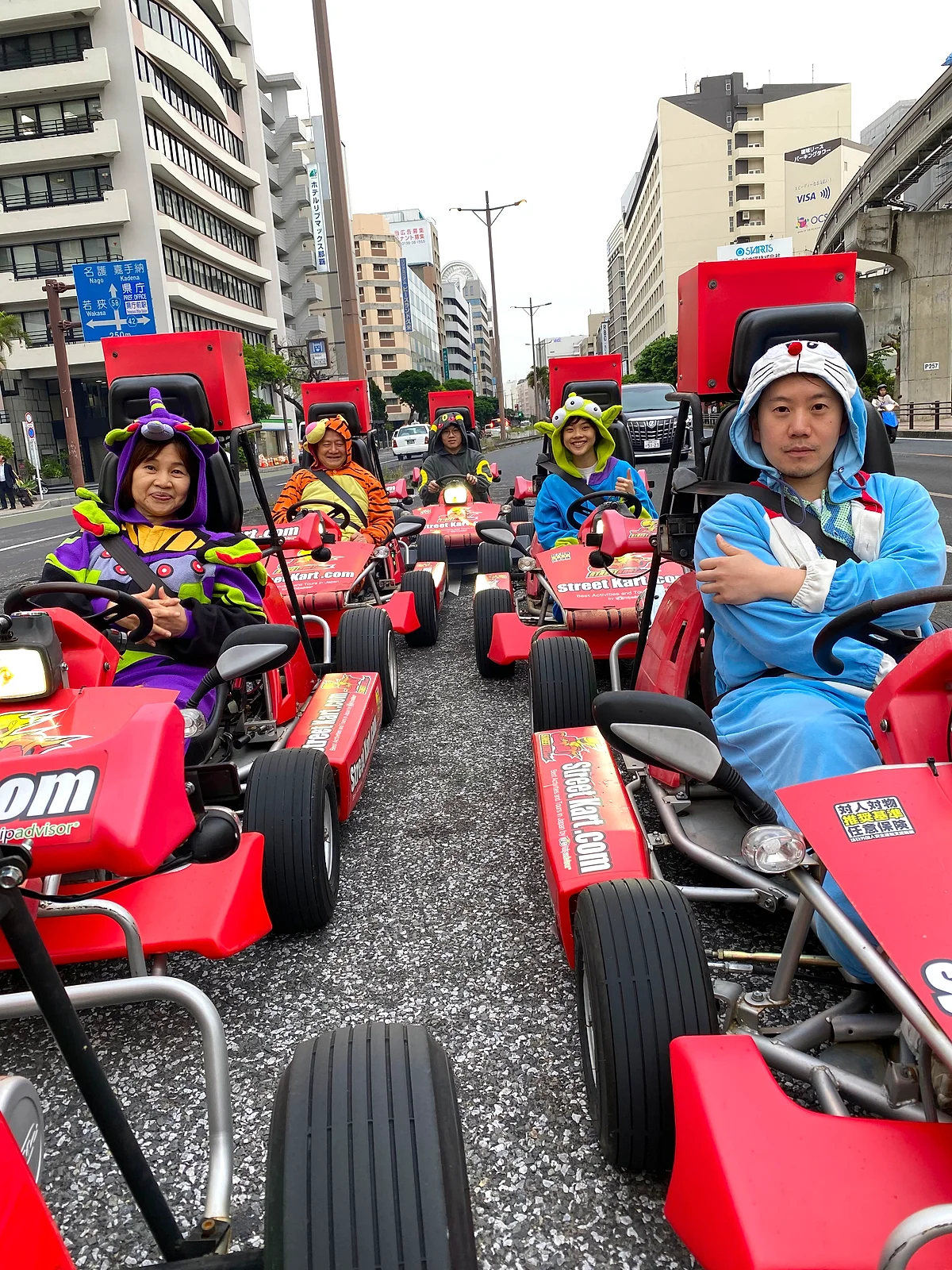
I love the sight of a line of little karts puttering down the street. The drivers look like they've become part of the cityscape.
Step 2: Check Whether Your License Lets You Drive
Next comes your license. The worst thing that can happen is finishing all your travel plans and then realizing, "Wait, my license doesn't let me drive here..."
Which countries' licenses are accepted, whether you need an International Driving Permit, and what to bring on the day all depend on where you live and the type of license you hold. Don't guess. Check your own case on the official license page (https://kart.st/en/drivers-license/), which also lists the detailed requirements.
You also need the original physical license. Digital licenses on your phone are not accepted. If you don't have the original with you on the day, you can't take part, and you won't get a refund. When you pack, put it in the same pouch as your passport so you don't forget it.
Honestly, the key to enjoying a drive through autumn Tokyo is not skipping this step. Rushing to gather documents right before your trip is stressful. A good rule: open the license page the same week you book your flight.
Step 3: Choose a Location Based on Its Autumn Scenery
Street Kart has 9 locations in Japan (7 in Tokyo, 1 in Osaka, 1 in Okinawa). Of the 7 in Tokyo, though, Akihabara stores 1 and 2 are right next to each other, and so are Shibuya and Shibuya Annex. So you aren't choosing between seven separate areas of Tokyo. Your choices are areas like Shibuya, Akihabara, Shinagawa, and Tokyo Bay (Shin-Kiba).
If scenery is your priority in autumn, pick by the feel of the route. Keep in mind that the peak of Tokyo's autumn foliage moves earlier or later from year to year. Colors can't be guaranteed, so check weather forecasts and announcements from the places you plan to visit before you travel.
Shibuya & Shibuya Annex: Under Omotesando's Zelkova Trees
The autumn route that comes to mind first is Omotesando, which the Shibuya and Shibuya Annex tours pass through. The kanji may look hard, but it's read "Oh-moh-teh-sahn-doh."
The stars of this street are the zelkova trees lining both sides. The tall trees go on and on past distinctive buildings by well-known architects, such as Omotesando Hills and Tokyu Plaza Omotesando Harajuku. As autumn goes on, the leaves slowly turn yellow and brown. Look up from the low kart seat and the branches should meet overhead like an arch.
As you drive, autumn sunlight flickers through the gaps in the branches above you. Depending on the time of year, fallen leaves may crunch under your tires. The kart has no roof or windows, so you feel the cold of the wind, hear the noise of the city, and smell the fallen leaves directly. That's what makes street karting special.
Still, it's no good if you get so caught up in the trees that you stop paying attention to the wheel. You're following a guide, so keep a safe gap from the kart in front. It's best to save the looking up for when you're stopped at a light.
The Shibuya tours also go through Harajuku's Takeshita Street. Meiji Jingu Shrine, Yoyogi Park, and NHK Hall are all near the route. Meiji Jingu is a shrine surrounded by about 700,000 m² of forest.
By the way, if you see the characters 「紅葉」 on signs or in the news, they mean autumn foliage. They're read "kōyō" or "momiji." It's a common word in seasonal news, so knowing it makes local information easier to search for.
Akihabara, Shinagawa, and Tokyo Bay: Taking In the City's Autumn Moods
Even where tree-lined foliage isn't the main attraction, other routes still give you a taste of Tokyo in autumn.
The tours from the Akihabara stores pass the red-brick Marunouchi building of Tokyo Station, the Ginza 4-chome intersection with the Wako clock tower, and Chuo-dori, lined with the signs of Electric Town. Kanda Myojin Shrine and Ochanomizu, home to the Holy Resurrection Cathedral (Nikolai-do), are also near the route. Tokyo Station's building opened in 1914, and restoration work on it was completed in 2012. Under a clear autumn sky, the red brick may look especially sharp.
The Shinagawa tour's scenery centers on the high-rises around Shinagawa Station, Tokyo Tower in the distance, the Rainbow Bridge, and the Takanawa area, with its historic temples and embassies.
The Tokyo Bay (Shin-Kiba) tour takes in the 798-meter Rainbow Bridge across Tokyo Bay, the 333-meter Tokyo Tower, and the Odaiba waterfront. On this route you feel autumn in the wide sky over the water more than in tree-lined streets. The wind can be strong along the water, so I'd bring an extra layer.
Autumn is also when the sun sets early. The Tokyo Bay store offers evening tours where you can enjoy the night views, and at night the Rainbow Bridge is lit up in seven colors. Availability for each time slot varies by date and plan, so check the official website.
Step 4: From Booking to the Day of Your Tour
Once you've picked a location, it's time to book. Reservations are accepted through Facebook, LINE, and email. Contact details are on the official website, so use whichever method suits you.
One thing to note: weekends book up fast. Once your dates are set, book early. If your schedule has some room, consider weekdays too.
Tour length, departure times, and the details of how the day goes all differ by location and plan. I can't give exact details here, so check the official website when you book. If anything is unclear, the quickest way is to ask when you contact them to book.
Autumn is also typhoon season, so know the weather policy. In light to moderate rain, tours go ahead as planned and raincoats are provided free of charge. Tours are canceled in heavy rain or typhoons. In that case, you can choose to join a shortened tour and get the difference refunded, move to another date, or cancel for a full refund. So you have the option to reschedule, avoid booking your tour for the day before you fly home.
On the day, take the train or other public transportation to the store. There's no parking at any location. For example, Shibuya and Shibuya Annex are a 5-minute walk from Shinsen Station and 10 minutes from Shibuya Station. The Akihabara stores are 3 minutes from Suehirocho Station and 5, 7 minutes from Akihabara Station. Shinagawa is 3 minutes from Kita-Shinagawa Station, and Tokyo Bay is 8 minutes from Shin-Kiba Station.
Japanese stations have many exits, and if you take the wrong one, you can be lost the moment you come up to street level. Search for the store in a map app and check which exit to use the day before. It makes the day much easier.
Travel light. The lockers at the stores are for small items and won't fit large luggage like suitcases. Drop your bags at your hotel first.
For autumn in Tokyo, wear layers that are easy to take off and put on. Wear closed-toe shoes, such as sneakers. Sandals, heels, skirts, and dresses aren't suitable for driving, so avoid them. Your body is out in the open on a kart, so you feel the wind more than when you're walking. While driving, focus on the wheel. Save the phone photos for walking around before or after the tour.
Step 5: Walk to See the Autumn Leaves After the Tour
Once the tour is over, it's time to go see autumn on foot. The places below are not on the tour routes. They're spots you can walk to before or after your tour.
From Shibuya and Shibuya Annex, Meiji Jingu and Yoyogi Park are each about a 20-minute walk. I'd also recommend strolling down Omotesando, the street you just drove. Looking up at the zelkova trees from the ground, the height and the view differ from what you saw in the kart seat, and you'll probably think, "Oh, so that's what it looked like." For photos, stand at the edge of the sidewalk where you can see the trees stretching into the distance, and crouch down a little. It brings out the depth of the avenue.
At Meiji Jingu, it's Japanese custom to bow lightly before passing through the large torii gate at the entrance. The center of the approach path is considered the path of the gods, so people usually walk along the sides. Knowing just this much lets you visit calmly, even for the first time.
From the Akihabara stores, Kanda Myojin is a 10-minute walk, the Imperial Palace 25 minutes, and Ueno Park 5 minutes by train. Kanda Myojin is known as the "guardian shrine of all Edo" and has 1,300 years of history. After driving among the signs of Electric Town, a visit there shows you an older side of the same neighborhood. From Shinagawa, Shinagawa Shrine is a 5-minute walk, the Takanawa Prince Hotel with its Japanese garden is 15 minutes, and Sengakuji Temple is 20 minutes. From Tokyo Bay, Odaiba and Toyosu Market are each about 10 minutes by car, which makes them easy to add before or after a tour.
In autumn leaf season in Tokyo, you can see the trees from a kart and then look up at them on foot, all in one day. You see the city's autumn with the wind on your face, then take it slow on foot. If it were me, I'd always do both.
First, check the license page to confirm you can drive. Then look at the locations and tours on the official website. If you're aiming for a weekend, book early.
Seen from a low seat, the sky over autumn Tokyo looks a little bigger.
This article was originally written in Japanese and translated using AI. Some expressions may read unnaturally, and we appreciate your understanding. For the most accurate and up-to-date information, please refer to the official site at kart.st.
Street Kart is not affiliated with Nintendo or the Mario Kart series in any way. We do not provide costumes of Nintendo characters, and such costumes may not be worn during tours even if brought by participants.