
Before Your Second Rainy Day in Tokyo: How to Prepare for Rain, and What to Check When It Rains on the Day You've Booked a Street Kart Tour
Before Your Second Rainy Day in Tokyo: How to Prepare for Rain, and What to Check When It Rains on the Day You've Booked a Street Kart Tour
The sky outside the window is gray. The hotel lobby is crowded with people looking for umbrellas. You only ran as far as the station, and your shoes are already soaked through. Most of your plans for the day are gone.
Plenty of people have spent their first rainy day in Tokyo this way. It would be a shame to let that turn you against Tokyo's rain, though. If it caught you off guard once, you can be ready for it the second time. This article goes through the Tokyo rainy-day basics that first-time visitors to Japan often don't know about, and what to check if the sky turns gloomy on the day you've booked a street kart tour.
What Actually Went Wrong on Your First Rainy Day?
The first rainy day isn't hard because of the rain. It's hard because you don't know what's going to happen next.
Where can I buy an umbrella? What do I do with a wet umbrella when I walk into a building? Is my activity still on? If not, who's going to contact me? On a trip without a fixed plan, all these little questions pile up at once. Any one of them is easy to deal with. When they all hit together, though, staying put in the hotel starts to feel like the easiest option. That's understandable.
In Taiwan, lots of people ride scooters in the rain. They throw on a yǔyī (Chinese for "raincoat") and head out as usual. Rain is part of daily life, not a big event. Tokyo is actually the same. Trains run in the rain, and shops stay open. The only difference is a handful of small rules that make getting around easier once you know them.
So the second time, learn the answers before you head out. Then even a rainy day can be a proper day of your trip.
Tokyo Rainy-Day Basics That Can Catch You Off Guard
First, umbrellas. Japanese convenience stores sell clear plastic umbrellas. Near every Street Kart location, there's a 7-Eleven, FamilyMart, or Lawson within a five-minute walk. If it suddenly starts pouring, there's no need to panic.
Next, entering buildings. Japanese shops and shopping centers often have umbrella stands or long, thin plastic bags for wet umbrellas at the entrance. Walking around a store with a dripping umbrella wets the floor and makes it slippery, so it's frowned upon. Either bag your umbrella at the entrance or leave it in the stand. That's the basic rule.
One thing to watch out for here: umbrella stands fill up with umbrellas that all look alike. Clear plastic umbrellas are basically identical. A sticker on the handle or a small marker on the shaft will save you some trouble. Walking off with someone else's umbrella is a real breach of etiquette in Japan. Even if it's an honest mistake, it's awkward, so a marker really does help.
Trains are also on your side when it rains. Tokyo stations are often connected to underground passages and station buildings, so you can walk a surprisingly long way without getting wet. On a crowded train, though, a wet umbrella tends to brush against the people next to you. Fold it and hold it in front of your body. It's a small thing, but knowing it makes getting around more comfortable for everyone.
There's one more trap inside stations. On rainy days, the floors in front of ticket gates, on stairs, and in underground passages are wet from everyone's umbrellas and shoes. Tiled floors are much more slippery than you'd expect. You'll sometimes see people lose their footing just past the ticket gates and grab the handrail. The more of a hurry you're in, the shorter your steps should be. On stairs, walk on the handrail side. That alone means a lot fewer close calls.
Finally, shoes. Plenty of people learned this the hard way on their first rainy day. Keep a spare pair of socks in your bag. That alone can change how your afternoon goes. Personally, I think it's the single most useful tip.
If It Rains on the Day You've Booked a Street Kart Tour
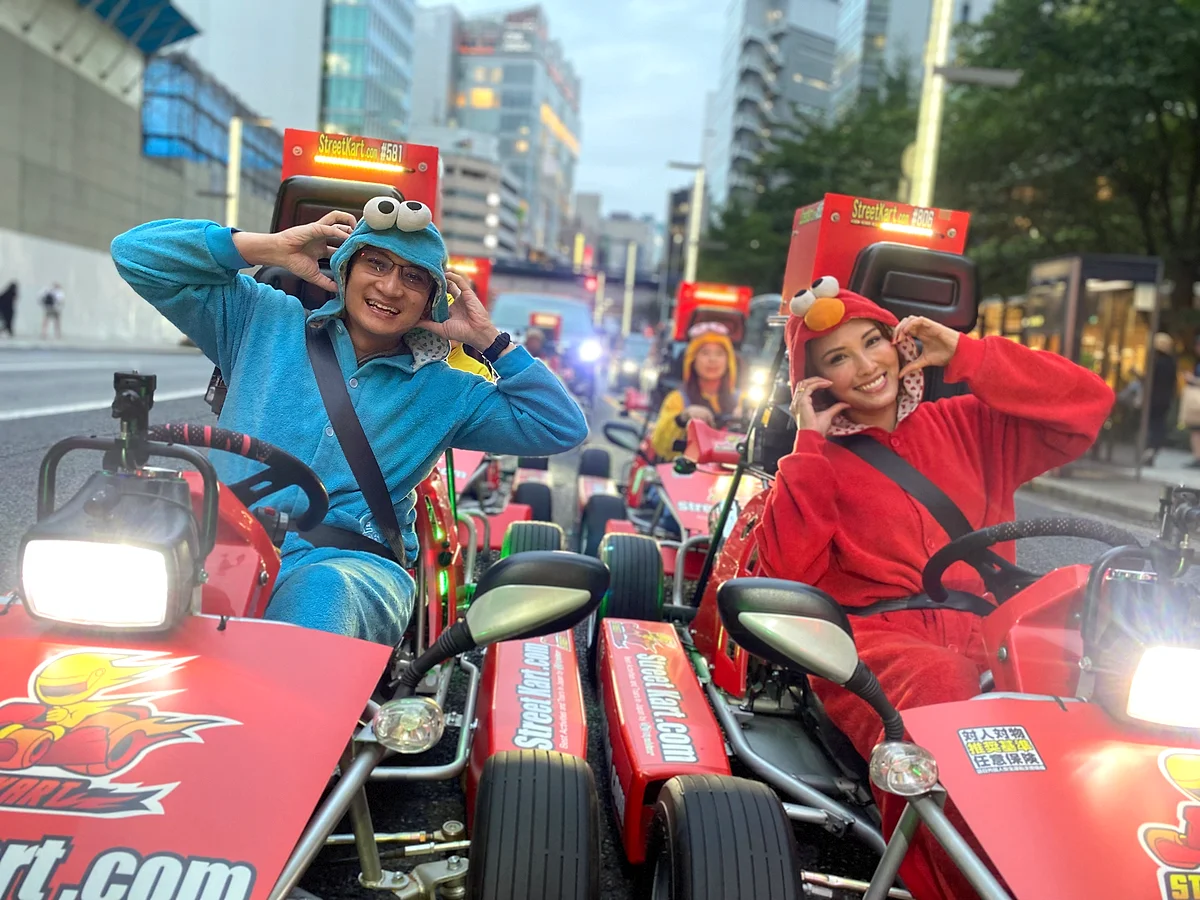
The rest of this article is for people who have booked a street kart tour in Tokyo.
The most important point first: this article can't tell you whether a tour will run in the rain, or what you'll need if it does. The store makes that call, and it can vary by location and by the weather on the day.
For reference, here's how Street Kart's weather policy works. In light to moderate rain, tours run as scheduled, and raincoats are provided free of charge. In heavy rain or typhoons, tours are canceled, and longer courses may be shortened. If a tour is canceled, three options are listed: join a shortened tour and get the price difference refunded, move to another date, or cancel for a full refund. Which one to pick depends on the rest of your travel schedule. Keep in mind this only describes the general policy; the actual decision on the day is always made by the store. If the forecast shows rain, read the weather information on the Street Kart official website, and ask the contact you booked through about anything you're unsure of. You can book and ask questions via Facebook, LINE, or email, and the contact details are on the official website.
When you get in touch, include your booking date, store name, and number of people up front. That speeds things up. Also, tour guidance on the day is basically in English. Whether you can get guidance in Japanese or other languages depends on the staff that day, so it can't be promised. If you're a little nervous about English, it's a good idea to prepare your questions in a translation app ahead of time. Google Translate's camera feature can also read Japanese notices posted outside shops. If you come from a country that uses Chinese characters, you may be able to roughly guess what signs mean.
One more thing: when to book. Weekends tend to fill up, so booking early is recommended. If the weather makes you want to change dates, there may not be many open slots on weekends. If your schedule has some room, keep two or so backup dates in mind. That way you can talk it over calmly even when you see rain in the forecast.
Next, getting to the store. When it's raining, it's tempting to take a taxi, but the stores don't have parking. Roads also tend to get congested on rainy days, and going by car can make you late for your booking. Public transport such as trains is the reliable choice. Rainy-day traffic is almost impossible to predict based on what you're used to on sunny days.
On the day, you'll check in at the store and get a safety briefing covering how to operate the kart, the route, and important precautions before you set off. On rainy days, the walk from the station to the store also tends to take longer than usual, since you're holding an umbrella. Leave your home or hotel with plenty of time to spare. If you're definitely going to be late, contact the booking channel as soon as you know. That makes things easier for everyone than apologizing after you arrive.
Clothing deserves extra attention on rainy days, too. Street Kart's guidelines recommend closed-toe shoes, ideally sneakers. On the other hand, they ask you to avoid open-toe shoes, heels, skirts or dresses, and expensive clothing. On a rainy day, you might be tempted to go out in flip-flops since you'll get wet anyway, but on this day, wear sneakers. Pick comfortable clothes you won't mind getting wet or dirty. Helmets and goggles are provided free of charge at the store.
Thinking about your luggage ahead of time will also save you some stress. The stores have lockers for small items, but they aren't suited to large luggage like suitcases. If your tour is on the day you check out of your hotel, leave large bags in a station coin locker or similar before heading over. Recommended items to bring include a camera or smartphone, a portable battery, and a small bag that fits on the kart. On rainy days, add a zip-top bag, and you'll have somewhere to put your phone or a wet folding umbrella.
Driver's license requirements are listed on the official website. Rules differ by country and license type, so be sure to check before your trip. Don't let this trip you up before the rain even does.
Street Kart's Appeal, Seen Through a Rainy-Day Lens
First, a trained guide leads each tour. It's your first time in Tokyo, and you don't know the roads or how traffic flows. Even so, all you have to do is follow the guide in front of you. Each store has its own set courses, so there's no need to plan a route yourself. Honestly, for travelers without a fixed plan, this makes things very relaxing.
Second, the vehicle itself. The karts are single-seaters, and passengers aren't allowed. You drive through the city with your own hands on the wheel. For example, the Shibuya store's Tour H2S goes from the Shibuya Scramble Crossing through Dogenzaka, then along the zelkova-lined avenue of Omotesando toward Harajuku. Along the way, there are stops at photo spots. That's exactly why you'll want to know in advance how the weather will affect you, even more than on a sunny day. It's the real reason rainy-day preparation matters.
Third, the choice of locations. In Tokyo, you can choose from areas such as Akihabara, Shibuya, Shinagawa, and Tokyo Bay in Shin-Kiba. You can choose based on where you're staying or which neighborhood you want to visit that day.
How to Spend the Time Before and After Your Tour, by Store Area
The time before and after the tour is where your second rainy day really shines. The places listed here are near the stores, not on the tour routes. Think of them as spots to visit on foot before or after your tour.
The Akihabara store is surrounded by places where you can stay under a roof. Yodobashi Camera Akihabara is a 3-minute walk from the store, and Animate Akihabara is a 2-minute walk. Browse electronics and anime goods for a while and you'll forget about the rain. This is the first area my Taiwanese friends want to visit when they come to Japan, and they're amazed by the selection at the electronics stores and drugstores every time. If you want to go a little farther, Ueno Park is 5 minutes away by train, with the Tokyo National Museum and the National Museum of Western Art. Museums are quiet on rainy days, and time seems to slow down.
From the Shibuya store, Shibuya Hikarie and Shibuya PARCO are both a 10-minute walk. You can shop and eat without leaving the building. If you love ramen, head to Ichiran Shibuya, a 10-minute walk away. Hot broth really hits the spot when the rain has chilled you. The Shibuya Scramble Crossing is also a 10-minute walk. On rainy days, umbrellas open all at once and neon reflects off the wet pavement. It feels like a different city from the one you see on a sunny day. If you're taking photos, looking down from somewhere a little higher up gives a good angle. Just 15 seconds of footage of colorful umbrellas moving in every direction is surprisingly mesmerizing.
From the Shinagawa store, Shinagawa Station is a 10-minute walk. Atre Shinagawa and Shinagawa Intercity, both directly connected to the station, have plenty of shops and restaurants. The store is a 3-minute walk from Kita-Shinagawa Station, so if you come by train, you won't be out in the rain for long. If the rain is light, visit Shinagawa Shrine, a 5-minute walk away. At the top of the stone steps, the greenery in the shrine grounds looks even deeper when wet with rain.
The Tokyo Bay store is in Shin-Kiba, an 8-minute walk from Shin-Kiba Station. The station has a café and restaurant called CASICA, which is a good place to wait if you arrive too early. Odaiba is about 10 minutes away by car, with large shopping centers like DiverCity Tokyo Plaza and Aqua City Odaiba. If you have time after the tour, eating indoors while taking in the bayside view is a nice option. After the rain stops, the air along the bay is often clear, and you can sometimes see the outlines of distant buildings sharply.
Every store has restrooms and Wi-Fi. That's worth remembering in case the rain throws your plans off a little.
Making Your Second Rainy Day Part of the Trip
On your first rainy day, there was too much you didn't know, and it stopped you in your tracks. The second time will be different. You already know how to buy an umbrella, the rules at building entrances, and how to hold your umbrella on the train.
If you've booked a street kart tour, what you need to do is simple. Before your trip, check the driver's license requirements on the official website. If rain is forecast, check the weather information and ask the contact you booked through. Weekends tend to fill up, so once your dates are set, book early. On the day, wear sneakers, leave your large luggage somewhere first, and take the train to the store. That's all there is to it.
Rainy Tokyo is also a city where neon blurs across the pavement and the streets fill with the colors of umbrellas. The next time it rains here, don't just watch from your hotel window. Grab an umbrella and head outside.
This article was originally written in Japanese and translated using AI. Some expressions may read unnaturally, and we appreciate your understanding. For the most accurate and up-to-date information, please refer to the official site at kart.st.
Street Kart is not affiliated with Nintendo or the Mario Kart series in any way. We do not provide costumes of Nintendo characters, and such costumes may not be worn during tours even if brought by participants.